Hot water efficiency explained: systems, costs, and payback for Australian homes
Hot water efficiency explained: systems, costs, and payback for Australian homes
Last updated: April 2026
What you need to know about hot water
Hot water accounts for approximately 25% of household energy use in Australia. Upgrading to a more efficient system is one of the highest-ROI investments you can make.
Quick comparison:
Electric resistance storage: High running costs, cheap upfront
Heat pump (air source): Low running costs, moderate upfront, eligible for rebates
Solar hot water: Low running costs (sunny regions), higher upfront, space required
Gas (storage or instantaneous): Moderate costs, depends on gas tariff
The best choice depends on your climate, your current system, and your tariff.
How different hot water systems work
Electric resistance (storage tank)
An electric element heats water in an insulated tank, similar to a large kettle. Water is kept hot throughout the day and night.
Pros: Cheap to buy and install, works in all climates, simple to maintain Cons: Uses 3–4 times more electricity than a heat pump, higher running costs
Running cost example (NSW, $0.32/kWh): A typical household using 200L/day pays ~$500–600/year to run an electric resistance system.
Heat pump hot water (air source)
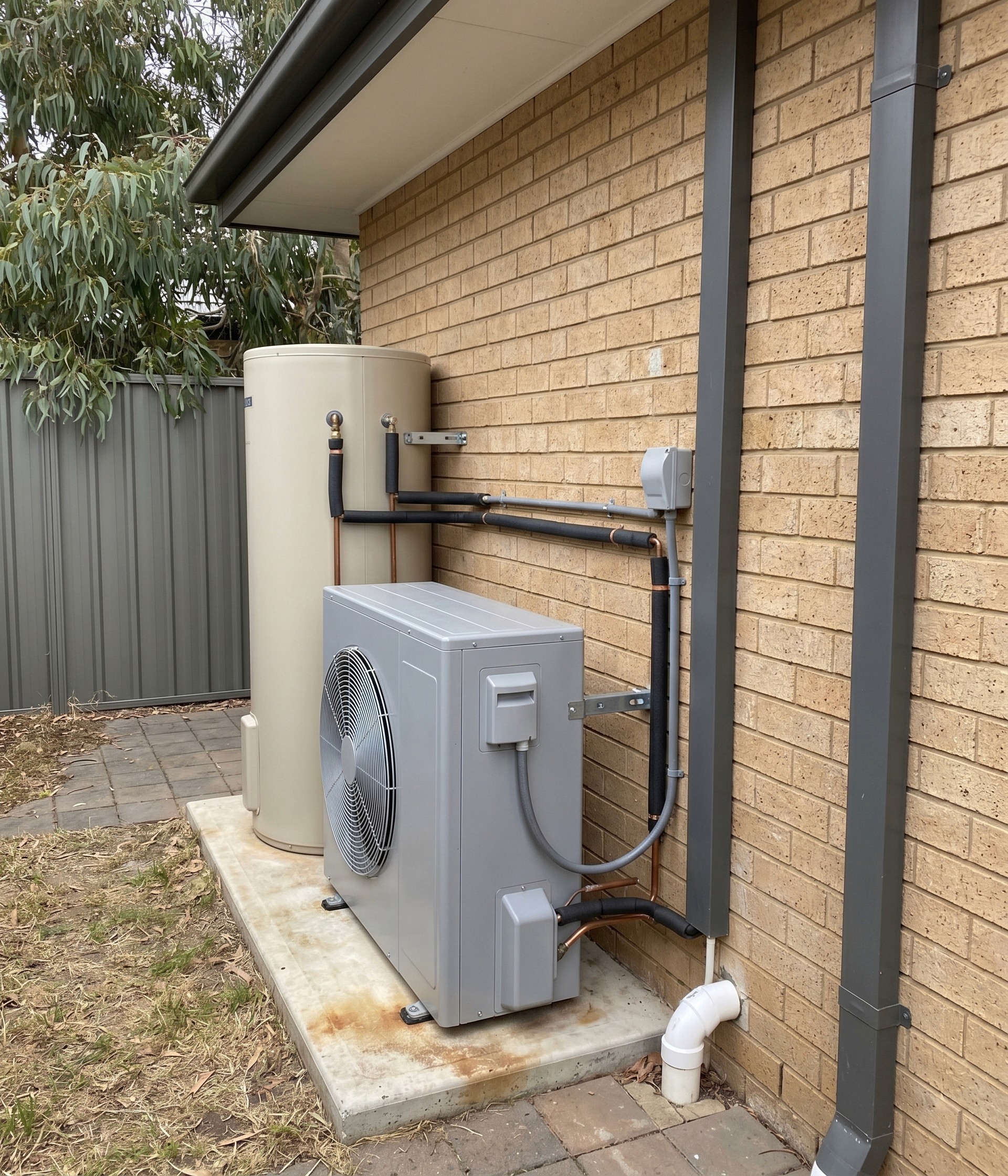
A heat pump transfers heat from the surrounding air to heat water. It works like a reverse air conditioner, extracting ambient heat rather than generating it from electricity.
Pros: Uses up to 75% less energy than electric resistance, works in most Australian climates (even down to -7°C in many models), eligible for government rebates, lower running costs offset higher upfront cost
Cons: Higher upfront cost (~$2,500–4,500 installed), requires outdoor location for the heat pump unit, performs best in moderate-to-warm climates
Running cost example (NSW, $0.32/kWh): A typical household using 200L/day pays ~$150–200/year to run a heat pump system.
Payback period: 4–6 years in most states (including rebates and STCs)
Solar hot water
Dedicated thermal collectors on the roof heat water directly. Most systems include an electric or gas booster for cloudy days or winter.
Pros: Very low running costs in sunny climates (QLD, WA), eligible for government rebates, no moving parts (long lifespan), works passively on sunny days
Cons: Requires roof space, higher upfront cost, lower efficiency in cold/cloudy climates, less efficient than heat pump in southern states
Running cost example (sunny climate like Adelaide, $0.38/kWh): A typical household with a gas-boosted solar system pays ~$100–200/year (booster use varies by season).
Payback period: 4–8 years depending on climate and boost fuel
Gas (storage or instantaneous)
Gas heats water either by storing it in a tank (storage) or heating on-demand (instantaneous). Natural gas or LPG.
Pros: Familiar technology, low upfront cost for storage, instantaneous systems are compact
Cons: Runs on fossil fuels (higher emissions), gas tariff can increase, storage systems can waste energy keeping water hot 24/7, instantaneous systems have high gas usage spikes
Running cost example (SA gas tariff ~$0.035/MJ): A typical household using 200L/day pays ~$350–450/year, depending on system type.
Government rebates and incentives (April 2026)
Federal: Small-scale Technology Certificates (STCs)
Available for solar hot water and heat pump systems
More efficient systems generate more STCs
STCs reduce upfront cost at point of purchase
Value varies by postcode (solar zone affects solar hot water; efficiency rating affects heat pumps)
Typical value: $800–1,500 depending on system
State schemes (examples):
NSW: Energy Savings Scheme (ESS)
Available for heat pump and solar hot water systems
Replaces or upgrades from electric resistance or gas
Discount applied at point of purchase (no rebate form to submit)
Typical discount: $800–1,000+ (varies by system efficiency and postcode)
Important: Heat pump rebates are typically higher than solar hot water in NSW
SA: Residential Energy Efficiency Scheme (REES)
Heat pump hot water systems eligible
Rebates available; check energy.gov.au for current amounts
VIC/QLD/WA/TAS/ACT:
Check your state government website for current heat pump and solar hot water incentives
Schemes change frequently; verify before making decisions
Important: You may be eligible for BOTH federal STCs AND state rebates — combine them for maximum savings. Licensed installers can claim these on your behalf.
Assumptions for cost estimates
All running cost examples above assume:
Household size: 3–4 people
Daily hot water use: ~200 litres
Temperature: 60°C storage (you mix down to safe shower temp)
Actual costs vary based on: your tariff, your climate, how much hot water you use, system age and condition
Making the decision
If you currently have electric resistance heating: Heat pump is almost always the better choice. It uses 65–75% less energy, is eligible for the most generous rebates in most states, and pays back in 4–6 years.
If you have solar PV panels (rooftop solar): A heat pump hot water system that runs during the day (when your solar generates) is often more cost-effective than adding a separate solar thermal system. You're leveraging your existing investment.
If you live in a sunny region (QLD, WA, parts of SA): Solar hot water is competitive with heat pumps. Both are good options — choose based on roof space and your preference for maintenance.
If you have gas heating and want to switch: Compare heat pump vs. solar hot water using your local rebates and tariffs. The payback period is usually 4–7 years.
If you have limited roof space or noise sensitivity: Solar thermal goes on the roof (no outdoor unit needed). Heat pumps require an outdoor unit and can be 46–50 dB (some models quieter). Factor this into your decision.
Installation and warranty
When choosing an installer:
Ensure they are licensed to claim rebates on your behalf (federal STCs and state schemes)
Get quotes from at least 2–3 installers to compare final costs after rebates
For heat pump systems, check for a minimum 5-year warranty covering the heat pump unit, tank, and components
Confirm the installer arranges all rebate paperwork (you shouldn't need to do this)
How it fits with other upgrades
Hot water is one of the three priority upgrades in the whole-of-home energy upgrade roadmap. The sequence is:
Insulation (envelope) — reduces heating/cooling load
Heating/cooling systems (heat pumps for space heating/cooling)
Hot water — typically 25% of household energy use
Appliances
Solar
Upgrading hot water is high-ROI because it's 25% of your energy use and has short payback periods (4–6 years with rebates).
For more details on sequencing and cost-benefit, see the whole-of-home energy upgrade roadmap.
What to read next
Whole-of-home energy upgrade roadmap — prioritised upgrade sequence with payback data
Heat pumps for Australian homes — types, costs, payback (includes space heating + cooling)
Insulation R-values explained — what insulation you need by climate zone
Sources
NSW Climate and Energy Action: Hot water upgrade incentive (energy.nsw.gov.au)
ACT Government: Hot water heat pumps (climatechoices.act.gov.au)
National Construction Code 2022, Part B2: Heated water services (ncc.abcb.gov.au)
Electrify 2515: Hot Water Guide (electrify2515.org)
Gridly: Solar Hot Water vs Heat Pump Australia 2026 (gridly.com.au)
Australian Energy Market Commission: Average market pricing data
Tips and Tricks
Explore more guides to scale your business


Subscribe to our newsletter
Stay up to date on rebates, offers, and energy-saving tips By subscribing you agree to our Privacy Policy.