Whole-of-home energy upgrade roadmap for Australian homes

Whole-of-home energy upgrade roadmap for Australian homes
Last updated: April 2026
Making your home more energy efficient is not a single decision. It is a sequence. The order you do things in affects your payback, your comfort, and whether later upgrades actually perform as promised. This guide walks through that sequence clearly, with costs and assumptions stated.
What "whole-of-home" means in practice
A whole-of-home approach treats your house as a system, not a collection of individual appliances. Insulation affects how hard your heating and cooling works. Draught sealing affects whether your insulation performs as rated. Hot water accounts for roughly 25% of a typical Australian household's energy bill, so it cannot be treated as an afterthought.
The Australian Building Codes Board's whole-of-home framework formalises this by rating homes across heating, cooling, hot water, solar generation, and pool/spa loads together rather than in isolation.
The upgrade stack: what to do in order
The sequence below is based on cost-effectiveness and interaction effects. Doing generation (solar) before envelope (insulation, sealing) is a common and expensive mistake.
Step 1: Envelope first Ceiling insulation, wall insulation where accessible, and draught sealing. These reduce the load on every system that follows. Skipping this step means your heat pump and solar are working harder than they need to.
Step 2: Heating and cooling Replace gas ducted or resistive electric systems with reverse-cycle heat pumps. With the envelope sorted, you can right-size the system accurately.
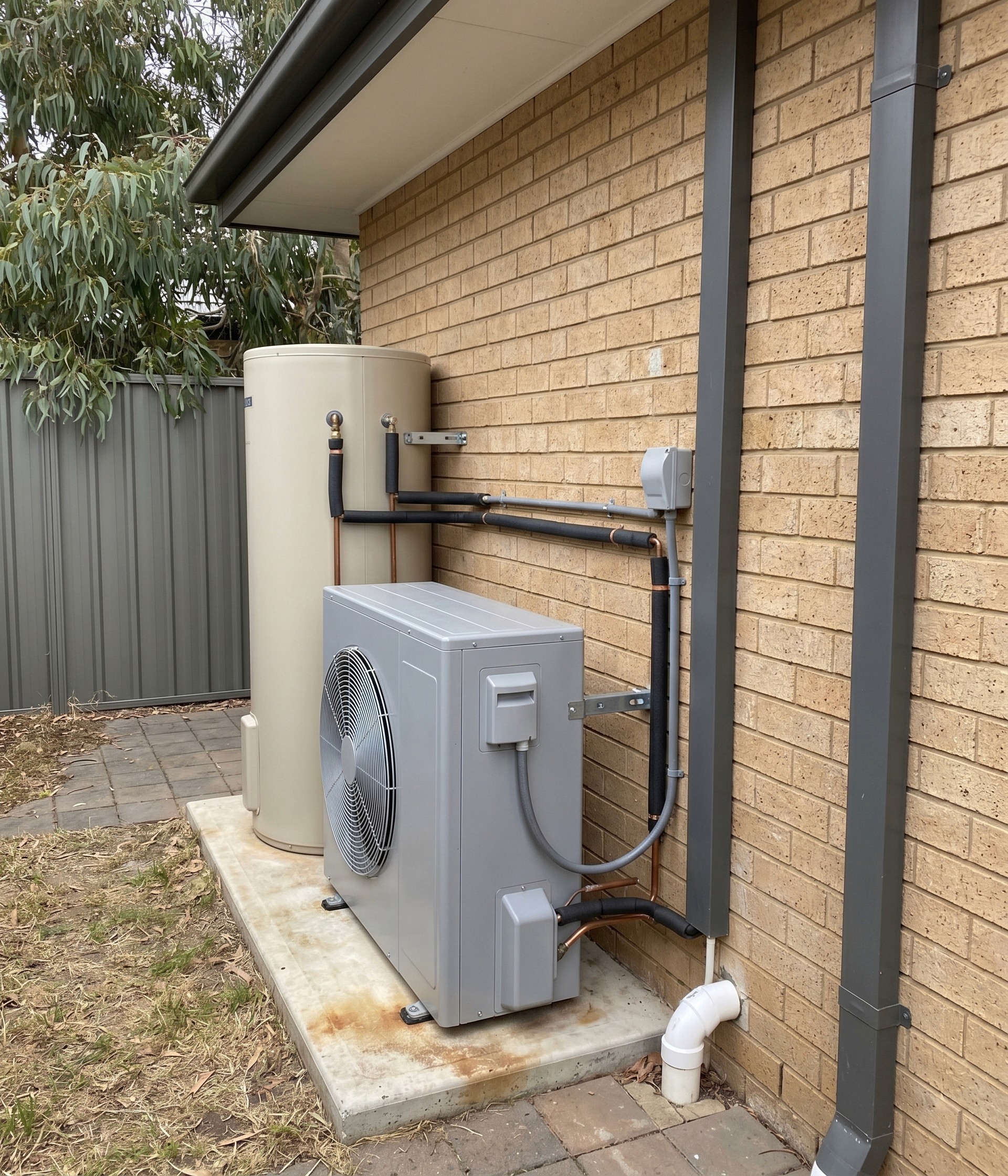
Step 3: Hot water Switch from gas or electric storage to a heat pump hot water system. This is one of the highest-impact single upgrades available to Australian households.
Step 4: Appliances and behaviour Shift high-consumption appliances (dishwasher, washing machine) to off-peak or solar hours. Review standby loads.
Step 5: Solar PV and battery Once loads are reduced and efficient, size your solar system to what you actually need. Batteries make sense in specific situations; see our solar and battery decision guide.
Upgrade comparison table
Assumptions: 3-person household, SA electricity tariff $0.38/kWh, gas tariff $0.035/MJ, replacing mid-age existing systems. Costs shown are installed, after typical rebates where applicable.
Upgrade | Typical Installed Cost | Est. Annual Saving | Approx. Payback | Do First? |
|---|---|---|---|---|
Ceiling insulation (uninsulated home) | $1,500 - $2,500 | $400 - $600 | 3 - 5 years ((ICANZ, cited by energy.gov.au) Energy Australia) | Yes |
Draught sealing | $200 - $800 DIY/pro | $150 - $300 | 1 - 3 years | Yes |
Reverse-cycle split system (7kW) | $2,000 - $3,000 | $600 - $900 | 2 - 4 years | After envelope |
Heat pump hot water | $2,500 - $4,000 | $500 - $700 | 3 - 5 years ((ACT Government, cited by energy.gov.au) Energy Australia) | After envelope |
Solar PV (6.6kW system) | $5,000 - $8,000 | $900 - $1,400 | 4 - 7 years (YourHome, cited by energy.gov.au) Energy Australia | After loads reduced |
Home battery (10kWh) | $10,000 - $14,000 | $300 - $600 | 15+ years | Situation dependent |
Worked example
Household: 3-person home in Adelaide, 1980s brick veneer, ducted gas heating, electric storage hot water, no solar.
Starting annual energy cost: approximately $3,800 (gas + electricity combined).
Upgrade sequence and cumulative impact:
Step 1, ceiling insulation and draught sealing: cost $2,800, annual saving $550, new energy cost $3,250.
Step 2, reverse-cycle heat pump replacing ducted gas: cost $2,500, annual saving $850, new energy cost $2,400.
Step 3, heat pump hot water: cost $3,200 after rebates, annual saving $620, new energy cost $1,780.
Step 4, 6.6kW solar PV: cost $6,500, annual saving $1,100, new energy cost $680.
Total investment: $15,000. Total annual saving: $3,120. Whole-of-home payback: approximately 5 years.
Common mistakes and how to avoid them
Installing solar before insulating. Solar offsets consumption but does not reduce it. Insulate first, then right-size your solar.
Oversizing the heat pump. A bigger system is not better. Oversized units short-cycle, reducing efficiency and lifespan. Get a proper heat load calculation.
Ignoring hot water. It is one of the largest loads in the home and one of the fastest payback upgrades available. Most households deprioritise it and leave money on the table.
Sealing without ventilating. Draught sealing a poorly ventilated home increases condensation and mould risk. Address ventilation before aggressive sealing, particularly in older homes.
Rebates vary by state and change frequently. In SA, the Retailer Energy Productivity Scheme (REPS) provides a financial incentive for heat pump hot water systems of around $930 for households without gas connections. SolarQuotes Nationally, a federal Cheaper Home Batteries Program began 1 July 2025, providing around a 30% discount on eligible small-scale battery systems. 1 Million Women Always verify current eligibility at energy.gov.au before purchasing
What to read next
Tips and Tricks
Explore more guides to scale your business


Subscribe to our newsletter
Stay up to date on rebates, offers, and energy-saving tips By subscribing you agree to our Privacy Policy.